


Saliva Self Test
Why choose REALY?
Professional Team
REALY has a development department dedicated to the development of IVD reagents. Our technical staff is responsible for process development, process improvement, and formulation development.
Quality Assurance
We have CE certificates, ISO 13485 quality system certification, Manufacture License, and Marketing Authorization in the country of origin. We are also preparing the FDA and other certificates.
Strict Quality Control
Maintain strict quality control during the process. Our product safety is checked through extensive testing, sampling and verification procedures to meet final product specifications.
Sales to The World
We participate in medical exhibitions in many countries such as Medlab, Medica, and AACC every year. The sales network has covered more than 80 countries and regions, distributing high-quality products at very competitive prices.
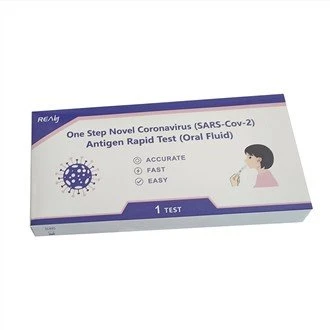
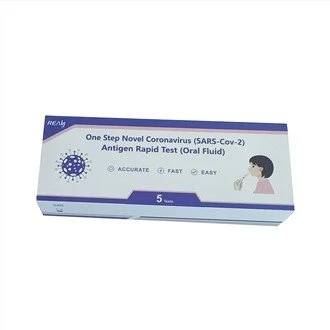
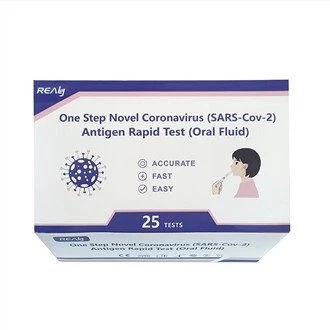

Saliva testing or Salivaomics is a diagnostic technique that involves laboratory analysis of saliva to identify markers of endocrine, immunologic, inflammatory, infectious, and other types of conditions. Saliva is a useful biological fluid for assaying steroid hormones such as cortisol, genetic material like RNA, proteins such as enzymes and antibodies, and a variety of other substances, including natural metabolites, including saliva nitrite, a biomarker for nitric oxide status.
Principle of Saliva Self Test
The COVID-19 Ag Rapid Saliva Test Device uses double antibody sandwich immunoassay. The NC membrane pre-immobilized with monoclonal antibodies against SARS-CoV-2 antigen and anti-mouse polyclonal antibodies, and the colloidal-gold conjugated with monoclonal antibodies specific to SARS-CoV-2 antigen. If SARS-CoV-2 antigen is present in the sample, a complex is formed between the anti-SARS-CoV-2 conjugate and the antigen will be caught by the specific anti-SARS-CoV-2 monoclonal antibodies coated in the test region (T). Results appear in 10 to 20 minutes in the form of a red line that develops on the strip. Whether the sample contains the SARS-CoV-2 antigen or not, the solution continues to migrate to encounter another reagent (an antimouse IgG antibody) that binds the remaining conjugates, thereby producing a red line on the control region (C).
Benefits of Saliva Self Test
Easy to Collect
This test only requires collection of saliva in a sterile container, as opposed to deep nasal swab (i.e., the nasopharyngeal (NP) swab), which can be uncomfortable for the patient and requires trained personnel wearing special personal protective equipment (PPE) to collect.
Fewer Collection Supplies Required
Saliva can be collected in sterile containers that are widely available, cheap and do not require special preservatives or containers. In these times, during which supplies are scarce, this is very desirable.

Fewer Steps in Testing
Testing for nucleic acids by molecular amplification (i.e., PCR) generally requires the viral RNA to be removed from the specimen and purified. The Saliva test uses a simple procedure that does not require instrumentation to open the virus and remove the viral RNA.

Instrument Accessibility
The Saliva test can be performed on several types of instruments found in specialized clinical molecular laboratories, potentially allowing those laboratories to start testing without acquiring additional, expensive instruments.
Applications of Saliva Self Test
Use of Saliva in Screening Symptomatic Individuals
Although sensitivity will differ depending on the different sample collection technique and considering the limitations of this sample type, saliva may be used as an alternative for RT-PCR tests.
Use of Saliva in Screening Asymptomatic Individuals
Given the ease of use and the non-invasive nature of saliva collection, it can have great benefits if used for selfcollection and repeat testing of individuals in given settings. Saliva specimen can therefore be considered as an option for the detection of SARS-CoV-2 in asymptomatic individuals who are required to self-test frequently for occupational or other reasons.
Use of Saliva in Testing Childre
With saliva collection being easy and non-invasive, it should offer a feasible approach for widespread testing of SARS-CoV-2 in children.
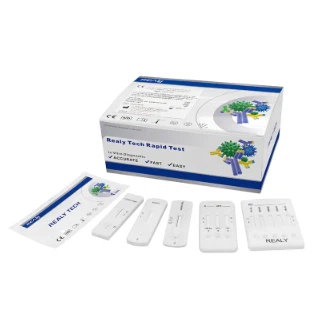
1. Test Device
2. Buffer & Filter Cap
3. Sample Collection Tube & Cap & Sample Collection Funnel
4. Instruction Manual & Quick Guide

Operation Steps of Saliva Self Test
Wash your hands before the test.
Remove the test from the packaging.
Take the saliva collector out of the base.
Remove the protector from the tip.
Deeply cough 4 times into your mouth.
Rub the collector tip against your tongue and the inside of both cheeks.
Place the collector tip under or to the side of your tongue.
Wait for 2 minutes with the collector tip inside your mouth, ensuring it stays at an upward angle.
After 2 minutes, remove the collector from your mouth and push the tip down firmly into the base.
Align the top of the base to the middle of the supporting ring.
Wait 15 minutes, then check your results. Results will be invalid after 30 minutes.
Place the kit into a plastic bag and dispose of using your household waste or rubbish bin.
Read Test Results
Positive Result
One coloured line should be in the control region (C) and another coloured line should be in the Test region (T).
*Note: The intensity of the colour in the test line region (T) will vary based on the amount of SARS-(CoV-2 antigen present in the sample. Any shade of colour in the test region (T) should be considered a positive result.
Negative Result
No apparent coloured line appears in the test line region (T) You are unlikely to have COVID-19. However, it is possible for this test to give a negative result that is incorrect (a false negative) in some people with COVID-19. This means you could possibly still have COVID-19 even though the test is negative. If you experience symptoms such as headaches, migraines, fever, loss of sense of smell or taste, contact the nearest medical facility according to the rules of our local authority.
Invalid Result
Insufficient specimen volume or incorrect procedural techniques are the most likely reasons for control line failure. Review the procedure and repeat the test with a new test or contact our COVID-19 test centre.
Precautions of Saliva Self Test Kit
- Each device is for single use only and cannot be reused.
- DO NOT eat, drink, smoke, brush teeth, or chew gum for 30 minutes before collecting saliva. DO NOT swallow.
- Keep out of the reach of children. Children 2-15 years of age should be tested by an adult. Children aged 15 and over should be assisted by an adult. Do not use this test on children under 2 years of age.
- Use a separate test for each person.
- This test is for human use only.
- Read the Package Insert prior to use.
- Do not use if pouch is damaged or open.

- It should be stored at 2℃~ 30℃, be kept dry and away from sunlight.
- The shelf life is 18 months.
- For per test, it should be used within 30 minutes after unsealing.
- Production date and expiration date are shown in the package label.
- Samples should be used as soon as possible after collection and should not be stored for a long time at room temperature. If the sample can not be detected in time, the sample can be stored for 48 hours at 2 ℃ - 8 ℃. Long term storage should be frozen at - 20 ℃, avoid repeated freezing and thawing.
Limitation of Saliva Self Test
Tests are for diagnostic purposes if you believe you may be infectious please contact your GP for additional assistance.
Test Card performance depends on the amount of virus (antigen) in the sample and may or may not correlate with viral culture results performed on the same sample.
Failure to follow the Test Procedure may adversely affect test performance and/or invalidate the test result.
Reading results in less than 10 minutes may lead a false negative result whilst reading results after more than 15 minutes may lead to a false positive result.
If the sample volume is not enough, the test cannot be carried out successfully.
Our certificate
We have passed various certificates such as CE and ISO, and the products we provide have quality assurance.


Common Problems of Saliva Self Test
As one of the most professional saliva self test manufacturers and suppliers in China, we're featured by quality products and good service. Please rest assured to wholesale cheap saliva self test from our factory. Contact us for more details.
antigen swab, at home antigen tests, rapid antigen test for travel