


Saliva Home Test
Why Choose Us
Our Factory
REALY has a dedicated development facility having a large pool of experienced scientists who are committed to development of IVD Reagents. Our R & D scientists are engaged in process development, process improvement, formulation and analytical development.
Certificate
CE certificates, ISO 13485 quality system certification, Manufacture License, Marketing Authorization in the country of origin.
Service Regions
Real Tech' s sales network has covered more than 80 countries and areas, providing an exciting opportunity for distribution of quality products at a very competitive price. We are dedicated to making the world a better place by providing people with high quality products and services.
Our History
Each year we participate in medical shows in various countries such as Medlab, Medica and AACC etc. We have got CE certificates, ISO 13485 quality system certification, Manufacture License, Marketing Authorization in the country of origin.
What is Saliva Home Test?
Saliva Home Tests are diagnostic tools that allow individuals to collect saliva samples in the comfort of their own homes for various health assessments. These tests are non-invasive, easy to use, and can provide insights into a wide range of health conditions and genetic predispositions.

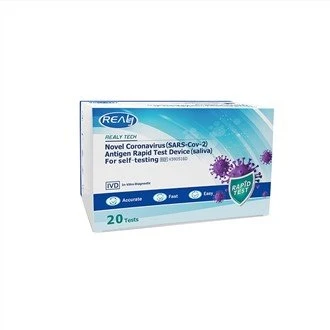
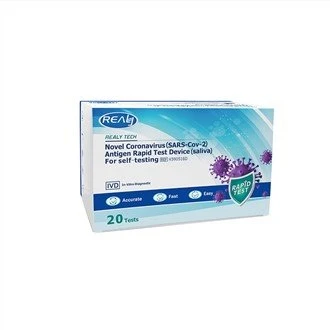
Rapid, At-Home Prototype Saliva Test That’s As Good As Rt-Pcr
At-home COVID-19 tests have become an easy way to self-diagnose. But current tests have drawbacks, such as the length of time it takes to get an answer, or how accurately the test can identify a positive case. And most of them require the uncomfortable procedure of sticking a swab up one’s nose. Now, researchers reporting in ACS Sensors have developed a SARS-CoV-2 saliva assay and prototype device that combine speed and ease with high sensitivity.
The two main options for at-home COVID-19 testing today are rapid antigen tests and those based on reverse transcription polymerase chain reaction (RT-PCR). Rapid antigen testing delivers a result directly to the user in about 15 minutes, but it’s not very sensitive and can provide a false-negative signal, meaning someone could unknowingly infect others. Though RT-PCR is known as the “gold-standard” assay because of its high sensitivity and specificity for SARS-CoV-2, it requires the sample to be sent away to a lab and be analyzed by specialized personnel. The analysis itself can take up to an hour, but the total time from swab to answer can take days. Plus, both methods require the uncomfortable process of swabbing the back of your nose.
Non-invasive saliva-based tests exist, but they also rely on the slow and specialized RT-PCR approach. A similar method called reverse transcription loop-mediated isothermal amplification (RT-LAMP) can also detect viral SARS-CoV-2 RNA at a level of specificity and sensitivity consistent with RT-PCR, but it’s quicker, cheaper and easier to use. Therefore, Weihua Guan and colleagues wanted to see if they could use RT-LAMP to create a fast and sensitive COVID-19 test that only requires a saliva sample; a palm-sized, portable device; and a smartphone.
The researchers integrated several steps into one compact machine, which they call the saliva-based SARS-CoV-2 self-testing with RT-LAMP in a mobile device (SLIDE). Its five distinct modules conduct all of the steps needed for RT-LAMP: heating the sample, mixing it with RT-LAMP reagents, carrying out the reaction, detecting how much viral RNA is present and communicating that result to a smartphone. To use SLIDE, a person simply spits into a vial on a cartridge that they insert into the device, and results are sent to a smartphone within 45 minutes. In lab tests, SLIDE successfully detected and quantitated a mock saliva sample spiked with inactivated SARS-CoV-2 virus particles, as well as a real saliva sample from someone known to be positive for COVID-19. In both cases, the results were consistent with those from RT-PCR, which suggests that the SLIDE device could be a quick, easy and sensitive way to tell whether someone has COVID-19, say the researchers.

First at-home saliva test for COVID-19 earns FDA approval
He U.S. Food and Drug Administration (FDA) has approved the first at-home saliva collection test for COVID-19, which people could use to sample their own saliva and send it into a lab for results.
Developed by, a biorepository based at Rutgers University in New Jersey, the test received "amended emergency use authorization" from the FDA late on May 7, according to a statement from the university. In April, the lab received emergency use authorization for their saliva collection method, which allowed health care workers to begin testing New Jersey residents at select sites throughout the state, The New York Times reported April 29.
Now, the amended authorization will allow people to collect their own saliva at home and avoid potentially risky contact with people at testing sites. The only other at-home coronavirus test on the market requires users to collect samples using a nose swab, The New York Times reported May 7.
"Collecting a saliva sample at home mitigates the risk of exposure needed to travel to a facility or drive-through and is less invasive and more comfortable and reliable than sticking a swab up your nose or down your throat,"
When compared with swab tests for the coronavirus, which rely on samples collected from the nose and throat, the saliva-based test generated fewer false-negative results in severely infected people, meaning it was more reliable at confirming an active infection, according to the Times report published April 29.
Benefits Of Saliva Home Test
Salivary diagnostic tests: A solution to IVD’s shortcomings
There is no magical, one-size-fits-all solution for the issues IVDs face. However, the emergence of salivary diagnostic tests – which use whole saliva and other oral sample types for biomarker detection – latter two issues outline above.1-3 Saliva collection and testing can be an easy an inexpensive sampling method with minimal discomfort to the end user, and is both accurate and easy to use as a portable and scalable platform for disease detection. For a multitude of different diseases.
Saliva provides improved safety through non-invasive collection
The collection of blood, or phlebotomy, is necessary for a huge range of diagnostic tests, making it one of the most common invasive procedures in healthcare.4 Though commonly accepted as a necessary part of diagnostics, when done without the proper procedure, the invasive nature of phlebotomy can lead to the exposure of healthcare professionals to blood-borne pathogens, such as HIV, hepatitis viruses, bacteria, and parasites.
Saliva is an easier sample type to self-administer in presence of a healthcare provider
Nasopharyngeal swabbing and phlebotomy both require the collection of samples by a trained healthcare professional, foundational training of personnel on how to safely perform collection, a scheduled location and timing for collection, and the use of PPE to limit exposure to pathogens.
Better Stability and Transportability
Using saliva as a sample type allows decentralized self-collection, even in areas without access to a medical system. As long as there is a way to transport samples from a patient’s residence to a testing facility, a decentralized testing system provides significant advantages. With SARS-CoV-2 testing, many emergency authorized tests have implemented at-home kits that use saliva collection methods and several studies have demonstrated the stability of SARS-CoV-2 RNA in saliva, under a variety of storage conditions.
How It Saliva Home Test Works
There are two saliva- or oral fluid–based tests that have received Emergency Use Authorization (EUA) from the FDA to diagnose active SARS-CoV-2 infection: the Rutgers Clinical Genomics Laboratory TaqPath SARS-CoV-2 Assay (the Rutgers test) and the Curative-Korva SARS-CoV-2 Assay (the Curative-Korva test).They are both molecular reverse transcriptase polymerase chain reaction tests that detect the virus’s genetic material in a specimen provided by an individual deemed by their health care provider to be at risk for COVID-19.
The first saliva test to receive EUA by the FDA was the Rutgers test.This test can be used to detect SARS-CoV-2 in multiple sample types, including a saliva sample. The assay is designed as a diagnostic test to detect ribonucleic acid from SARS-CoV-2 in respiratory droplets from patients with suspected COVID-19.For saliva sample testing, the sample must be collected using the Spectrum Solutions LLC SDNA-1000 Saliva Collection Device.Under an update to the original EUA, the saliva specimen can be self-collected.To collect the sample, the individual spits directly into the collection device. The sample is then stored and transported to the Rutgers clinical genomics laboratory for testing.Testing of the specimen must take place within 48 hours of collection.
The Curative-Korva test also received EUA by the FDA.The test can be used to detect SARS-CoV-2 in respiratory specimens from a variety of sample types, including oral fluid specimens.Unlike the Rutgers test, the Curative-Korva test requires the oral fluid specimens to be collected using a swab. In general, the collection of samples for swab-based oral fluid tests usually involves having an individual cough several times before swabbing the inside of both cheeks for several seconds.Although the specimens can be self-collected according to the EUA, the specimens must be collected under the supervision of a trained health care worker.The swab containing the specimen is then sealed in a tube for transportation to KorvaLabs where it can be tested.
At-Home Saliva Test Can Spot Covid Variants
(HealthDay)—Spit and scan. That's all you have to do, and in less than an hour, you can not only find out if you have COVID-19 but what variant you have, all without leaving your home.
This is the hope and promise of a new saliva-based COVID-19 test that is currently under development.
"Several at-home tests are available for telling you whether you have COVID-19, but none of them test for variants," said study author Dr. Xiao Tan, a clinical fellow at the Wyss Institute for Biologically Inspired Engineering at Harvard University, in Boston.
There are no plans to commercialize the test yet, but a new proof-of-concept study shows that the technology works as well as the gold standard PCR tests and could cost as little as $3 per test, which is a lot cheaper than currently available COVID-19 home tests.
By contrast, COVID-19 tests based on PCR technology require highly specialized equipment and can take roughly four hours for results. If a sample were to be tested for a specific variant using PCR technology, it would have to be genetically sequenced, which takes even more time and resources, Tan explained.
There are currently several at-home COVID-19 tests available. Some tests require samples be sent to a lab for analysis, while others provide results at home using various technologies such as test cards and processing fluid. No PCR tests can be processed at home.
So, researchers at the Wyss Institute, the Massachusetts Institute of Technology (MIT), and several Boston-area hospitals collaborated to develop the new test.
Home Remedies to Pass a Saliva Drug Home Test
Hydrogen Peroxide Rinse
How It Works: Hydrogen peroxide is a versatile compound found in many homes, it is used in the form of mouthwash to eliminate drug metabolites present in the mouth. The way it does this is by cleaving the metabolic products, which, in essence, destroys them and decreases the chances of a positive test reading.
Vinegar Rinse
How It Works: Apple cider vinegar is another popular home cure for various conditions such as mouth rinse for the mouth swab drug test. Apple cider vinegar is acidic and may help to wash away drugs in the mouth and stimulate saliva production to enhance drug absorption. Further, the ordinary use of apple cider vinegar is a natural antibiotic, which can assist in maintaining oral hygiene and decrease the density of drug metabolites.
Listerine Mouthwash
How It Works: Listerine is an easily procurable mouthwash with antiseptic properties which will assist in washing out any drug residuals from the mouth. Although there are drugs that are made for passing a saliva drug test, the very high concentrations of alcohol and essential oils present in Listerine have been known to lower the concentration of drug metabolites in saliva. This makes it more suitable for people who are interested in finding a quick and convenient solution to pass mouth swab drug tests.
Chewing Gum and Drinking Water
How It Works: Mint products like chewing gum and taking water are some of the natural ways that may be recommended to enhance saliva production in a bid to reduce the concentration of the metabolites in your mouth/oral cavity. Although these methods may be not as accurate as commercial detox products or other home remedies, they can be helpful to a certain extent and can be combined with the rest methods.
Lemon Juice and Water Rinse
How It Works: The sour taste of lemon juice is an astringent, which will help cleanse the mouth of drug metabolites with additional saliva in the stomach. Lemon may also reduce the chances of passing a mouth swab drug test because the acidic nature of its juice may get rid of the drug residue.
Our Factory
REALY has a dedicated development facility having a large pool of experienced scientists who are committed to development of IVD Reagents. Our R & D scientists are engaged in process development, process improvement, formulation and analytical development. This facility is recognized by State Food and Drug Administration, Government of China. COVID-19 Antigen Rapid Test Kits are our main product, including professional tests and home rapid test.

Certifications


FAQ
As one of the most professional saliva home test manufacturers and suppliers in China, we're featured by quality products and good service. Please rest assured to wholesale cheap saliva home test from our factory. Contact us for more details.
easy to use saliva test for personal health care at home, saliva test for early detection, free antigen test